Saturday, November 27, 2021

Lake Goddess – Shey Phuksondo


The famous lines of Firdaus, the Persian poet “if there is heaven on earth, it is here, it is here, it is here” has been an inspired verse for many beautiful places around the world.  Nepal is not just blessed with divine artistic Goddesses but also natural ones. One of the most powerful natural Goddesses that reside in our country is Lake Phuksondo in Dolpo. 

Few years back, I got the opportunity to visit this area. I was offered a ride by a friend working with the World Wildlife Fund (WWF) on a rural electrification project in the area. 

As I close my eyes and go back to that time, a feeling of serene satisfaction envelops me. I feel truly blessed to have seen this unravished and untainted natural wonder – Shey Phuksondo. It seems like all the celestial beings - the sun, the moon, the mountains, and the sky protect this heavenly abode on Earth. No natural calamity or man-made disaster has disturbed its existence. It has been untouched, unperturbed and undeniably revered by all nature and humankind. This unique natural wonder where there is no aquatic life except algae is worshipped by the local community and no human activity like bathing, swimming, or boating is allowed

It was a long and arduous two and half hour helicopter ride from Kathmandu on a cloudy monsoon day. It was the pilot’s first flight to Dolpo and as we traversed above and below the clouds, I simply shut my eyes hoping to reach there in one piece. But the danger, the fear and the anticipation was all worth it. As the helicopter circled the lake to land, my jaw dropped in absolute awe. I couldn’t believe the sight - a glistening gem that glitters with a glow, surpassing even the grandeur of the rising sun. I’m not exaggerating! The colors change from turquoise, to emerald, to sapphire to aquamarine as the position of the sun shifts across the sky. It seems like as if the lake is flirting with the sun and showing her admirer, her breathtaking beauty in every angle. 

The magnitude of the scene is inexplicable. Us spectators are simply stunned by what lies before our eyes. You feel like you have been transported back to mythological times where Gods came down from the heavens and resided on Earth. Such is the purity of the area, that it doesn’t feel like the current corrupt century.  
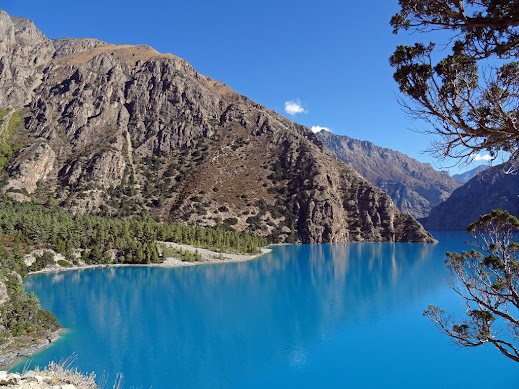

After I was done photographing, I sat down on a rock and just watched the lake for a long time. Besides wondering how this pristine beauty can exist in such perfection, a soothing stream of serene sensation flowed from my head to my toe. It was so therapeutic. Without any spoken word, the lake simply pacified me. Just like the clarity of the water, my muddled mind began to clear by itself and washed away all my worries.  The lake simply gave gentle and soothing vibes and I began to reflect on how blessed I am. I felt like Goddess Phuksondo was telling me “you have witnessed my beauty, my strength and my power, now why worry about anything? Make positive ripples and be clear and conscientious like me. You will then see your true colors radiating.” My internal conversations with the lake continued with deeper realizations.  Having witnessed such a heavenly natural beauty, one feels some sense of completeness; as if a life mission has been accomplished. 

Our religion conjures fancy man-made Gods and Goddesses based on complex philosophies that takes a lifetime to understand. In our quest to understand ourselves and the world around us better, we crave for clarity from spiritual gurus, religious texts, heritage, history and self-help books.  The more we learn, the more questions come up and perplexity continues. After all, the foundation of the human race thrives on creating confusion and chaos. From the dawn of civilization, when has peace ever reigned for long? 

Natural Goddesses like Shey Phuksondo with its silent, strong and clear message stir your soul and also puts matters very simply. Without having to study and question anything, your mind is just at peace. A quote by Albert Einstein explains it all “Look deep into nature and you will understand everything better.” 


A Woman’s Eyes Say It All – Kiran Manandhar


Kiran Manandhar, the flamboyant abstract expressionists' favourite statement is “I cannot paint anything else but women.” This may also be true for most traditional Nepali artists who usually paint Goddesses. Our art is mostly women based. In fact, the biggest inspiration for artists all over the world are women. Women in all forms, shapes, sizes, colour, age and depicting every possible situation and emotion.     

Looking back at the development of art in Nepal, for hundreds of years, women have always been painted in divine forms in paubhas with utmost devotion from the artists as their art requires them to reflect religious sentiments and faith. Then came the impressionists’ during the Rana era who painted in European styles but mostly focused on landscapes and portraits of the ruling class. Women were not the main subject. The abstract modernists in the 60s like Bangdel painted women but were not the focus of his attention. It was only in the 70s that an audacious Kiran Manandhar came into the scene and portrayed women continuously similar to the traditionalists painting Goddesses. 

What inspired him to be so dedicated to paint his fish eyed, sharp nosed beauties who have now become a trademark of Nepali contemporary art? Unlike the traditional portrayal of Tara, Vasundhara, Kurukulla and other deities, this abstract fish eyed beauty is not a Hindu or Buddhist deity. Who is she? Where did her inspiration come from? 

It so happens that while on a field trip in 1975 to the Khajuraho temples as a student of Visual Arts in Banaras Hindu University, Kiran was spellbound by the high relief carved sculptures on the temple walls. This 10th century temple has been an inspiration for many artists in the subcontinent to learn about women’s figures. The sensual postures, curvaceous bodies and exquisite carvings and expressions have simply enraptured many artists. Kiran was no exception, he was totally awed by the architecture, the ambience and the smoothly carved female figurines. He was so mesmerised that he immediately began to magically sketch the Khajuraho figures, which remain his first drawings of women.


In 1976, Kiran attended the Mardi Gras festival in Chennai. While loitering in the beach, observing the fishes in the ocean, the eyes and mouth of the fish struck him. It was very sensuous and womanly - well rounded, shapely and expressive. At some point during the thrilling and ingenious vibes of the Mardi Gras festival, the similarities between fishes and young women struck Kiran. Physically, both have elegant lithe bodies, eyes that glimmer with hope, and hungry luscious lips. Figuratively, both are heading towards destinations deep and unknown across the seas. Analysing the similarities, he turned the eyes of his feminine figures as a shape of a fish and along with it came the signature pouty lips. 

Kiran Manandhar’s women are usually depicted in vibrant playful backgrounds but in meaningful situations. If he portrays a group of women, then they can be seen in serious conversations or in deep contemplation.  It seems like the group of women are always talking about something purposeful and have a mission to fulfil. This you can simply feel and see it in the eyes itself. Though a simple oval shape, the eyes are the window to the soul of the art and the interpretation of his paintings is instantly derived from the eyes. 

If a sole woman is painted, then she is usually in a powerful situation of womanhood like the recently painted “Love and Passion” which shows a mother breastfeeding her child.  Here again the closed droopy fish eyes depict such pure eternal love for her child.

Traditional artists have focused on women’s posture, hand gestures, ornaments and the emotions evoked through the eyes has either been wrathful or compassionate as per the significance of the deity. But what about emotions of happiness, pain, sorrow, determination, longing, and other feelings? Such intensity and range of a woman’s feelings can be continuously seen in Kiran’s paintings. The passion and power of a lover, the compassion of a mother, the desire of a wife, the solidarity of friends is sensed and perceived in abstract but deeper meanings. As Kiran, himself says “I think abstract forms emanate from the act of getting deeper into the form and discovering what may not be easily possible for everyone to do.”

Each of Kiran Manandhar’s painting has a story of a woman behind it whether the subject is national or personal. As he says “My art expresses my joy, my sorrow and my attitude towards social issues.” His feelings, his abstract medium, and his hallmark fish eyes has expressed the story of contemporary Nepali women for decades now. Herein lies the “herstory” of many of us in canvas.


Reference: Discussions with Sagar Manandhar


Goddess Tara – tracing her origins


Tara is one of the most worshipped deities among Buddhists in Asia. Among the five Tara Goddesses - White, Yellow, Blue, Red, and Green, the Green Tara is most popular.  From Nepal to India, China, Japan and other Buddhist countries, her powerful and compassionate figure adorn the walls of many homes. 

My fascination with the Goddess started with a painting of Green Tara by Samudra Man Singh Shrestha displayed at the Museum of Nepali Art. A surreal green figure adorned with the most exquisitely crafted jewels draws the attention of all men and women. A coy look, a subtle seductive posture and magnetic yet soft eyes portray Tara as the most beautiful Goddess ever in the artists’ presentation. Vajrayana Buddhism Goddesses are truly an artists’ delight as most of them are imaginary figures, giving the artists - especially present day neo traditional ones - the freedom to create a heavenly figure of astounding beauty.      

But what is the history of this goddess who is so revered by Mahayana and Vajrayana sects all over the Asian continent?  While some scholars believe the interlocking of Vajrayana sect with Hinduism created several manifestations of deities to make converts worship Buddhist versions of Hindu Gods, others believe deities have their origin in Buddhism itself.

The difference between Hindu and Vajrayana Buddhist deities is that most Hindu gods and goddesses were mortals elevated to godly status with their exceptional life stories and good action. Buddhist deities, on the other hand, are mostly imaginary figures given a form to fulfill various religious needs and represent symbols similar to their Hindu counterpart. 

Hinduism’s innumerable gods and goddesses portray every human characteristic and need, and are an icon of worship to solve every problem under the sun.  In Vajrayana Buddhism too, there are a number of Bodhisattvas -ones who take the path to enlightenment but delay attaining it so as to help alleviate the suffering of other sentient beings - whose presence bear a parallel to the Hindu pantheon. 

There are some mortal bodhisattvas such as Manjushree and Padmasambhav, but most of them are imaginary figures. One such revered figure is the Green Tara. 

Some scholars believe Tara’s origin to be traced to Hindu tantric literature and the Puranas (Hindu religious scripts). According to scholar Hirnanda Shastri, the name Tara is found in Brahmanic literature as a synonym for Goddess Durga. She is described as Tara Amba (Mother Tara), the Patron of the Seas. Tara devotees consisted mainly of trading sailors, navigators and boatmen because the Puranas describe her as related to water bodies. She is named after the star “Dhruva Tara” as it is the main star that guides the sea journeys. It is thus explained by Hindu scholars that Goddess Tara got a place in Hindu theology before the 5th century, as a patron of the seas. It is also possible that Hindus who converted to Buddhism brought their Hindu deities along and had them assimilate into Buddhism in the course of time. 

The Buddhist version of Tara’s origin story says that she came into existence in the 5th century and the Hindus accepted her into the group of Shakti (feminine energy) goddesses. Tara’s earliest images, found in the Buddhist caves of Western India, date back to the 6-7th centuries suggesting the influence of the Shakti cult in Mahayana and Vajrayana Buddhism. Her first appearance in the coastal caves of the northern Deccan region and western India reinforces this status as the protector goddess of the seas. 

The Buddhist mythological version says she originated from the tear of Avalokiteshvara (male bodhisattva of compassion), which fell on to the ground and formed a lake. Out of its waters rose a lotus, which upon opening revealed the Goddess. Tara was thereafter known as the female equivalent of Avalokiteshvara,a compassionate deity who helps men “cross over to the other shore.”  Her emergence as a Bodhisattva thus can be seen as an attempt of Mahayana Buddhism to become more gender inclusive.

In Tibet, Green Tara manifests in the form of Nepali Princess Bhrikuti. The Licchavi Princess Bhrikuti Devi (7thcentury AD), who married King Tsongtsen Gampo of Tibet, had a big role in exporting the essence of Vajrayana Buddhism from Nepal to its neighbors, and was thus elevated to the celestial status of Bodhisattva Tara. The Tibetan king is believed to have sought for the Nepali princess as he was enchanted with the development of Buddhism in Nepal and wanted to introduce similar civilized culture, arts and architecture to Tibet.  

Whichever way you choose to look at the Green Tara -as a patron of the seas, the feminine bodhisattva of compassion, or in manifestation as Princess Bhrikuti Devi, the goddess captures you with her divine mystery. Unlike Hindu goddesses with heart wrenching life stories such as Sita or Sati Devi, the Green Tara is just an imaginary figure that portrays divinity in its most beautiful form.  

Not much is commonly known today of the origin of Green Tara, and her contemporary paintings rarely depict her as the protector of the seas. With Muslim invasions across the subcontinent from 11th century onwards, Buddhists escaped northward to Nepal and China, and with these changing religious landscapes, the Green Tara is usually portrayed in a backdrop of floating clouds, in the ‘tribhanga asana’ (a gracefully bent posture) or seated on a lotus pedestal. Her journey north from the sea coast to the mountains, synonymous with the star she represents - “Dhruva tara” – or the northern star, is yet another tale sidelined in mass consciousness, and yet another chapter of “Herstory,” of a prominent goddess of the Asian continent.


References:

1. Goddess Tara, a short study – Jagdish Chandra Regmi

2. Iconography of Buddhist deities – Min Ratna Bajracharya


Discovering Deities – Vasundhara, Goddess of Earth and Wealth


Trying to discover Goddess Vasundhara with Ritesh Shahi’s and Lok Chitrakar’s paintings at the Museum of Nepali Arts (MoNA) is a challenging task. Ritesh’s painting reminds you of a rich and royally clad Aishwarya Rai in one of the historical Bollywood movies. Her golden hues shine through the frame just like the movie filters that make the actress’s face glow through the screens. Elaborate and intricately carved jewelry, detailed printed brocade blouse, and her soft regal demeanor with a composed smile attracts the visitors instantly. The reflection of the yellow hue represents grain and gold as she is the goddess of earth and wealth, and you simply admire the dedication of the artist’s paint strokes to give her the shine that she radiates. 

Lok Chitrakar, being the master paubha artist, follows the protocol from ancient texts and is precise in his portrayal of how Vasundhara should be. The earth goddess is painted with water flowing below her as earth and water should always be two elements in congruence with each other. All her elements are in place and she is surrounded by her consort, Jambala (God of wealth) and other members of her deity family. Her crown holds Ratnasambhav, the Pancha Buddha symbolizing Earth. Many more motifs and elements are placed to explain the overall belief of the Vajrayana sect.

Vasundhara is a relatively minor figure in the Buddhist pantheon, but yet again an artistic delight as she can be decorated and elaborated endlessly. She is worshipped both in the Theravada and Mahayana/Vajrayana sect of Buddhism. Her role is highlighted as the sole witness to Buddha’s enlightenment in the Maravijaya (victory over temptations) episode where Buddha resisted all desires and did not succumb to the four main temptations – Klesa mara (emotions like greed, lust, hate, delusions); Mrtyu mara (fear of death); Skanda mara (defilements of past life); Devaputra mara (natural disasters). Being the sole witness to Buddha’s resistance to earthly temptations and disturbances is noted in the Pali texts of Cambodia and Siam. However, it is nowhere to be found in India or Burma and in Nepal, she is considered to be the Vajrayana version of the highly worshipped Hindu Goddess Laxmi.


Legend says and as conveyed by Lok Chitrakar, the Maravijaya episode is an incident when a person named Namochi Mara tried to claim the space where Buddha was meditating as his own personal area. Vasundhara sensed this and came to Buddha’s rescue by springing up from the Earth, wringing her hair to crack the ground open and bring out a deluge of water to stop Namochi Mara from disturbing Lord Buddha. If the legend was such, what could Vasundhara have been in a realistic sense? Was she a woman fetching water from a nearby river, and upon sensing Namochi’s intent to disturb Buddha, detracted him by splashing water from her pot? A figment of imagination for sure, and we can conjure many such explanations. But in the absence of evidence; legends and fables persist over years with philosophies added to make the story sanctimonious. 

It is ironic that Vasundhara who actually represents the “resistance of temptation” became a symbol of bountiful harvest and wealth in the Vajrayana sect. There is already a Goddess of Harvest, Annapurna Devi in the Vajrayana sect, who preceded the worship of Vasundhara. However, Vasundhara took upon the more popular form of Lakshmi symbolizing material and spiritual wealth. There is no clear explanation of how Vasundhara, a prominent figure in one of Buddha’s life events, became the representation of Lakshmi in Nepal - but assumptions can be made that her representation of mother earth in turn symbolizes wealth.  

In trying to understand religion and art, one stumbles upon so many questions that do not have logical answers, as they are coated in elaborate mythical explanations.  The artist is submerged in their aesthetic fervor, the priests in their ritualistic zeal, and the devotees blind in prayer. The questions of a curious, rational mind rarely find easy answers. How should one go about appreciating our millennia old religion, art and heritage in that case – especially a generation of educated individuals with rational and critical minds? 

At a recent exhibition, I saw a make-up artist completely enamored by Ritesh Shahi’s Vasundhara. The glow in her eyes while observing the painting in absolute rapture was a sight to behold. She said she is totally inspired to create this exquisite beauty with her own make up skills. I assume, the next bride will be inspired by Vasundhara? Such will be one of the uses for our art as each generation relates to it in their own ways.   

There is no easy answer, though a quote from the celebrated American poet TS Eliot provides a good thought: 

“No generation is interested in art in quite the same way as any other; each generation, like each individual, brings to the contemplation of art its own categories of appreciation, makes its own demand upon art and has its own uses for art.” 

This quote perhaps applies to our quest to appreciate Paubha art too, and in embracing the mysteries of figures such as Goddess Vasundhara. 


References:
• The Journal of the Royal Asiatic Society of Great Britain and Ireland No. 1 (Jan., 1925), Reviewed Work: Epigraphia Birmanica. Vol. I, Pt. I by Taw Sein Ko, Chas. Duroiselle pp. 145-148 (4 pages)

• Earth Goddess in the Art and Culture of Burma, Thailand and Laos. Joseph De Sarum, MA Thesis, Graduate School of the Ohio State University.

• Huntington, John C. & Dina Bangdel. The Circle of Bliss: Buddhist Meditational Art, “125| Vasundhara“.


Tuesday, June 1, 2021

Goddess Sita – an abducted wife, a single mother


“Don’t be afraid of the dark my child, light has a source. It can be snuffed out. But darkness has no source. It just exists. This darkness is a path to that, which has no source: God” Sita, Amish 

Darkness has so much power – it is a source for your inner light to shine. The story of Sita is enveloped in layers of a woman’s darkest miseries. Every woman who knows the story of Sita aches listening to her anguish. Yet her strength is the epitome of how much a woman can tolerate. Goddess Sita is the central figure of Ramayana, one of Hinduism’s most revered religious epics. She was the adopted daughter of King Janak of Mithila and wife of Lord Ram. It is believed she was found protected by vultures in the jungles of Southern Nepal. 

Sita was the princess of the Kingdom of Mithila in present day Terai and adjoining parts of India northward of River Ganga. The Janaki temple in Janakpur, which was the capital of Mithila, was built in honour of the Goddess. In 1657, a golden statue of Sita was found by the holy sage and founder of Janakpur, Sanyasi Shurkishordas. He built a temple on the very spot where the statue was found. The present-day Janaki temple was built in 1910 by Queen Vrishna Banu of Tikamgarh, India to mark Janakpur as the birthplace of Sita. It’s a wonder why an Indian Maharani would come all the way to Nepal to build the temple; she must have truly been a Sita devotee. 

Most of us in traditional texts and stories have read Sita being portrayed as the obedient and sweet wife of Lord Ram. For years, Sita has been in the mass consciousness of Hindu women as the ideal submissive sacrificing woman with unquestionable loyalty. Only in recent years with emerging feminist thoughts, Sita’s life has been analyzed deeper. Judging by her life story - a princess who was active in ruling Mithila, and a queen who lived in exile for most of her life; the real Sita must have been strong and resilient, not a woman needing identity through her husband alone. An evidential proof of this fact is an Upanishad (religious and spiritual teachings in Hinduism) dedicated solely to her ideals and philosophy. Out of the 108 Upanishads, one of them is the “Sita Upanishad.” 


The fate of Sita is paradoxically tragic. A queen and yet never having lived in queenly comfort. She married Lord Ram but soon had to leave for exile with him for 14 years. While in exile, she was abducted by Raavan, King of Lanka and was imprisoned in his palace. The great war between Lord Ram and Raavan to free Sita is the crux of Ramayan. Ram’s glorious victory is celebrated as Dasain and their triumphant return to Ayodhya as Tihar, the two biggest festivals for Hindus. Unfortunately, soon after returning to palatial life, she was exiled again, as her husband succumbed to accusations of her being unfaithful to him with Raavan while in abduction. She was pregnant then, and tragically had to give birth to her twin sons – Lava and Kush, in the jungle. 

Her end again is heartbreaking. Upon learning that he is the father of twin sons, Ram came to take his sons but did not accept his wife. Unable to bear the pain and the shame inflicted by her husband, she buried herself asking Mother Earth to envelope her. The true nature of her death is unknown as religious stories simply say she was taken back by “mother earth” for her biological mother was unknown. But we can perhaps assume it was suicide, or did she bury herself alive? 

Sita is an epitome of willpower, inner strength and embodies the greatest attributes of emotional perseverance. She died defiantly, challenging the judgment of Hinduism’s greatest God, Ram by imploring Mother Earth to embrace her as proof of her innocence. She is also a symbol of injustice that men inflict upon women throughout history and even today. The husband attained all the glory by being exiled, waging a war, winning against the evil forces and even being respected for banishing his pregnant wife, as it was perceived to be a moral decision. The wife on the other hand fought with the husband side by side in every obstacle and went through greater emotional and mental torture, yet she is just given a platform of worship along with the husband who misjudged her. 

They are rarely any women in history who have an individual identity if she is married. The fact that Sita had her own Upanishad is evidence that her character was so strong that even in those days she was entitled to an Upanishad. Yet in time, with more male historians in the offing, she lost her deserving place. History never judges the wrongdoings of a husband towards his wife. It is an accepted norm. Being Lord Ram, no religious text or history books have dared to question why he was so unfair to his wife and even if mentioned, it has been twisted in his favour. And Sita, the wife is mostly worshipped for being devoted and obliging to her husband’s wishes. Herein lies the bias of men writing “history,” a woman’s struggles, achievements and individuality - always overshadowed by that of men’s.

Tuesday, May 4, 2021

A forgotten hero, an infinite curse: The story behind Kazi Bhim Malla and his wife’s curse


“Hell hath no fury like a woman scorned!” The famous proverb from 18 century English writer William Concreve, is a popular term used to describe women’s anger. However, in the case of Nepal it is more like “Hell hath no fury like a woman’s curse” - in reference to Sati’s curse which has been pervading the Nepali psyche and our political and social scenarios. The curse is so deeply ingrained in our belief that every time there is a political fallout or a national crisis, us Nepalese use the term “sati ley sarapey ko desh.” (a country cursed by Sati) 

From the curses of the tombs of the Great Pharoahs of Egypt, to the curses of the ancient Mayan, Aztec and Incan civilisations, “the curse” is a segment of psychological and mental aspect of a nation’s historical belief which cannot be quantified. It does not have proper evidence but it exists and it impacts!! So, who is this woman whose curse is so powerful and why did she curse Nepal so badly? 

Before the advent of freedom of speech, history was a one-sided affair. The ruling kings directed what should be written. Many deserving persons did not get their due recognition. Kazi Bhim Malla, the husband of the woman who cursed the country is one such personality in the history of Nepal and his wife is paradoxically the “most famous yet anonymous” woman of this nation. She is just known as Sati because she committed “sati’ and cursed while doing so. What was her name? How old was she? Did she have children? There is no record of her at all and yet her curse has been permeating this nation ever since her death. 

Kazi Bhim Malla was a minister during the reign of King Laxmi Narsimha Malla (1620-1641) and his son King Pratap Malla (1641-1674). A man of considerable accomplishment, his contribution to the nation by a minister is so far considered to be the best ever in Nepal. However, some jealous officials persuaded King Pratap Malla that Bhim Malla was aiming to take his throne, and hence, the King put him to death. Distraught and utterly devastated, his wife on the pyre, cursed the country with such vehemence saying, “May there never be ‘bibeka’ (sound judgment) in this durbar.” It is believed that any wish or curse of a woman committing sati comes true. Her curse seems to have struck the country till today. The rulers upon knowing the truth later were so ashamed and guilty of what they did, that they brushed it aside as much as possible. But a contribution as magnanimous as Kazi Bhim Malla’s cannot be forgotten nor the ill fate of judging him wrongly. 

Bhim Malla established the best trade treaty ever. Nepali historians today say, no treaty in our history has been so favorable. Bhim Malla led the war with Tibet and brought Kuti and Kurseoung under Nepal’s control and was able to attain very good conditions for the growth of our economy. Only Nepali currency “Mahendramalli” could be used for trade and the exchange rate in gold, silver and salt was set by Nepal. All traders from the south and the north had to pass through Kathmandu valley and the city was an economic hub comparable to present day Dubai. Nepal reached a golden era of economic and cultural prosperity during Pratap Malla’s reign and 150 years further thanks to the treaty of Bhim Malla. 

After the takeover of the Shah dynasty, relations with Tibet took a downturn with the Sino Nepal war (1788-1792) over the case of minting low-quality coins for Tibet and later after Nepal lost the war with Imperial Britain losing two thirds of its land with the signing of the Sugauli Treaty (1814-1816), Kathmandu as a trade hub collapsed. 

It’s such a strange phenomenon that a curse of a woman can be so overpowering that it actually affects the “psycho-history” of this country. A term not much given historical validity but very much affecting human behavior, and an individual’s action is what affects a chain of historical events anyways. The story of Sati and Bhim Malla has a deep sentiment about the greatest injustice done to a man whose good intentions were all misconstrued and of a wife who was so overstruck with grief that in her helpless last moments she just cursed with all her might and force. A chain of unsound karmic occurrence thus followed henceforth and belief on karma is what us Nepalese rely on always. 

Most of history revolves around men’s might, their warfare and bravado. Waging war, conquering nations, killing for glory and success is what we mostly read, learn and elaborate upon. Do we ever read about women’s pain, grief and the outcome of such emotional suffering? It’s really not considered worth analyzing. It has no tangible outcome worth describing, it is just an emotion which cannot be given historical significance. Yet, there is a sub-conscious impact!! 

Just wonder, if history was written by women, how much of emotional intelligence or outcomes of emotional power would be given importance. Would emotional strength weigh as much as physical strength? Or would a woman’s “curse” be given as much importance as a man’s “conquest”? How do you weigh the helpless but ferocious cries of women to that of sheer visible ferocity of men? Here again what is written in “history” often escapes the intangible nuances of “herstory.” 


There is no picture or sculpture of Kazi Bhim Malla. The Bhulukha Dega temple in Yetkha Bahal is believed to have been built by Bhim Malla in memory of his father. There has been nothing built in later years to honor this great son of Nepal. The Bhulukha Dega temple was recently renovated by the Kathmandu municipality but no trader family of Kathmandu who benefited for generations from his trade treaty contributed to it. Sadly, Bhim Malla, has been forgotten through the ages by a nation who thrives on history and heritage but has limited knowledge about it. 

Reference: 
Dilli Raman Regmi, Madieval Nepal, Volume 1 
Munshi Shew Shunker Singh & Pandit Shri Gunanand, Nepal: History of the Country and the People (New Delhi: Cosmo Publications, 1983) 
Anil Chitrakar, Temple Trade, ECS Nepal, August 2010, Issue 21

The circular path of monotony

The circular path of monotony The circular path of monotony Slowly spins around my reality Sufficing my worldly needs I have no reasons to w...